
Skyrim on Vision Pro Concept
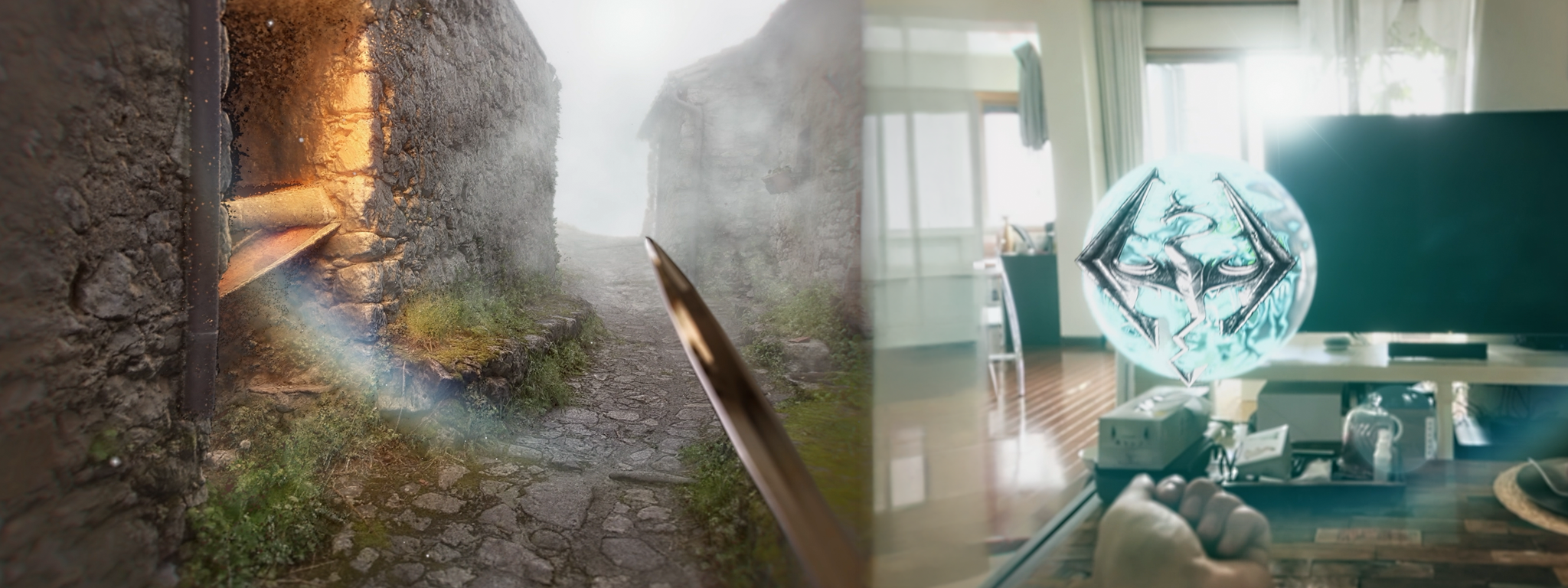
A spatial-gaming concept exploring how a player’s physical surroundings could gradually transform into an immersive virtual world.
Research · Spatial Computing · Volumetric Capture · Point Clouds · Unity · 2023
Featured by 80 Level, Creative Bloq, and MIXED
Unofficial fan concept. Not affiliated with Bethesda Game Studios or Apple.
Overview
What would happen if entering a game world did not require immediately leaving the physical world behind?
Shortly after Apple introduced Vision Pro, I created a visual concept imagining how a large-scale game such as The Elder Scrolls V: Skyrim could work on a spatial device.
Rather than reproducing conventional VR inside a new headset, the experiment focused on the transition between realities. The player begins inside an ordinary living room. Fragments of another place gradually appear within it, expanding through the walls, floor, and furniture until the physical room has been almost entirely replaced by a medieval environment.
The project was not intended as a playable port of Skyrim. It used the game as a familiar reference through which to explore a broader question:
Could future games treat immersion as a continuous process rather than a binary switch between AR and VR?
The Room as the Beginning of the Game
Traditional VR normally begins by replacing the player’s surroundings with a completely virtual environment.
Spatial devices introduce another possibility. The physical room can remain visible and become part of the opening composition, narrative, and interaction design.
In the concept, the living room acts as the first layer of the experience. The virtual world does not appear behind a conventional loading screen or through a rectangular portal. Instead, it begins to materialize directly within the player’s surroundings.
For a few moments, both realities coexist. Familiar furniture and walls provide a stable spatial reference while parts of the medieval environment emerge around them. As the transformation continues, the virtual world becomes increasingly dominant.
The transition itself becomes part of the experience.
A Spectrum of Immersion
The central idea was to treat immersion as something that could change continuously.
A spatial game might begin with only a few virtual objects positioned around the room. The environment could then expand as the player begins exploring, enters combat, or reaches an important narrative moment.
Different parts of the game could use different levels of immersion:
A map or inventory could remain spatially anchored within the room
Characters might initially appear beside physical furniture
A doorway could become an entrance into another location
The floor and walls could gradually acquire virtual materials
A major encounter could temporarily replace the room completely
Reality could return progressively when the experience ends
The player would not simply choose between “augmented” and “virtual” reality. The game could dynamically decide how much of each world should be present.
This could make immersion a narrative and mechanical tool rather than only a display setting.
Volumetric Transformation
Point clouds and Gaussian Splat became the visual bridge between the physical and virtual environments.
A conventional polygonal scene generally appears as a complete, solid object. It can be faded or clipped, but the underlying geometry still communicates a clearly defined surface.
Volumetric environments behave differently. Individual fragments can detach, accumulate, dissolve, and reorganize in space. The world can remain partially transparent without feeling like a conventional opacity effect.
For this concept, the medieval environment begins as a sparse collection of points. More information gradually enters the scene until walls, paths, vegetation, and architecture become readable.
During the transition, the viewer can see through the gaps between the two realities. The physical room has not completely disappeared, but the virtual environment is already spatially present.
The point-cloud aesthetic therefore serves a functional role: it makes the transformation itself visible.
Capturing Lucchio
The virtual environment was constructed from my own 3D scans of Lucchio, a semi-abandoned medieval village in Italy.
Its narrow paths, irregular stone buildings, vegetation, and layered architecture provided an environment that felt visually connected to the world of Skyrim without directly recreating one of the game’s locations.
Using a captured place also gave the concept a different quality from a traditionally modeled game environment. The architecture contained the uneven surfaces, small imperfections, and accumulated detail of a real location.
This created an unusual chain of realities:
A physical medieval village was volumetrically captured, reconstructed as a digital environment, and then imagined as a virtual world entering another physical room.
The environment existed somewhere between a scanned memory, a game level, and a simulated destination.
Why Use a Familiar Game?
Skyrim was partly chosen because of the recurring joke that the game has been released on almost every available platform.
More importantly, it provides an immediately recognizable example of an expansive world built around exploration, scale, atmosphere, and discovery.
Using a familiar game made it possible to communicate the spatial concept without first explaining an entirely new fictional universe. The viewer already understands what it means to enter the world of Skyrim.
The important part was not the idea of another technical port. It was how the relationship between the player, the room, and the game world might change on a spatial device.
Beyond Porting Existing VR Games
Early discussions around spatial gaming often focused on bringing conventional games or existing VR titles to new hardware.
This experiment suggested a different direction.
Spatial games could be designed around the fact that the device understands the player’s physical context. A room is not merely an obstacle that must be hidden before the game begins. It can become source material.
A table might become an elevated landscape. A corridor could extend beyond its physical dimensions. A window could reveal a distant virtual location. Characters might enter through real doors, while environmental effects spread gradually across existing surfaces.
The most interesting spatial experiences may therefore be those that do not immediately remove reality, but reinterpret it.
Transition as Part of the Narrative
The boundary between reality and the virtual world could also communicate the state of the game.
During calm moments, the room might remain partially visible. As tension increases, virtual content could occupy more of the player’s surroundings. Environmental changes could move closer to the viewer, obscure physical landmarks, or alter the perceived scale of the space.
Returning to reality could be equally important.
Rather than ending with an abrupt cut, the game world might fragment and recede. Virtual architecture could dissolve back into individual points, revealing the room underneath. Objects from the game might briefly remain behind as spatial traces before disappearing.
Entering and leaving the game would become designed moments rather than technical necessities.
Visual Prototype
The project was created as a speculative Unity prototype and presentation film. It was not running natively on Vision Pro and did not attempt to reproduce the complete interaction or gameplay systems of Skyrim.
The purpose was to communicate a possible visual and spatial experience:
A real room used as the starting context
A volumetric environment gradually entering the space
Continuous movement between passthrough and full immersion
A game world constructed from captured reality
Point-cloud transformations used as spatial transitions
By limiting the experiment to this central moment, I could focus on how the experience might feel before the hardware and development workflows were widely available.
Tools and Technology
Unity — Real-time scene construction, animation, and rendering
Volumetric capture and photogrammetry — Reconstruction of Lucchio
Custom point-cloud rendering — Presentation of the captured environment
Transformation shaders — Progressive appearance and dissolution of point data
Spatial composition — Alignment of physical and virtual environments
Real-time VFX — Atmospheric transitions and world-building effects
Credits and Coverage
Concept, volumetric capture, VFX, and Unity development: Ruben Frosali / RubenFro
Original game and intellectual property:The Elder Scrolls V: Skyrim, Bethesda Game Studios
Spatial-device inspiration: Apple Vision Pro
Featured by 80 Level in VR Skyrim for Apple Vision Pro Imagined with Unity, and subsequently covered by Creative Bloq and MIXED.